

Referrer Details
Make a referral
A major independent evaluation has found that the WEPROTECT service is delivering significant benefits for both victim-survivors of domestic abuse and police forces.
The study, funded by the Home Office, assessed the rollout of WEPROTECT across police forces in Sussex, Greater Manchester, and the West Midlands between October 2022 and March 2025. It included analysis of more than 3,300 domestic abuse cases, alongside over 220 interviews with police officers, survivors, solicitors, and frontline staff.
Led by the University of Birmingham’s Centre for Crime, Justice and Policing and supported by researchers from Brunel University London, the University of Nottingham, and survivor-led organisation We: Are, this represents the most comprehensive evaluation to date of a technology-enabled legal intervention for domestic abuse.
Supporting faster access to protection
We developed WEPROTECT to accelerate access to legal support and protection for those experiencing domestic abuse.
Through the service, survivors can be referred quickly into a pathway of free remote legal assistance. This includes support with applying for civil protection orders, legal aid assessment, and access to representation through an independent national Legal Partner Network.
The evaluation highlights that, when supported by strong police engagement and effective local partnerships, this approach can improve reporting, reduce revictimisation and empower survivors to pursue legal protection.
Professor Siddhartha Bandyopadhyay, Director of the Centre for Crime, Justice and Policing at the University of Birmingham, said:
“This is the most rigorous evaluation to date of a remote legal intervention for domestic abuse survivors. Our findings show that when implemented with strong police engagement and clear local partnerships, WEPROTECT can significantly improve reporting rates, reduce revictimisation and empower survivors to pursue legal protection. While there is more work to do to ensure equitable support for all survivors, WEPROTECT has proven to be a vital early intervention tool.”
Measurable impact for survivors and services

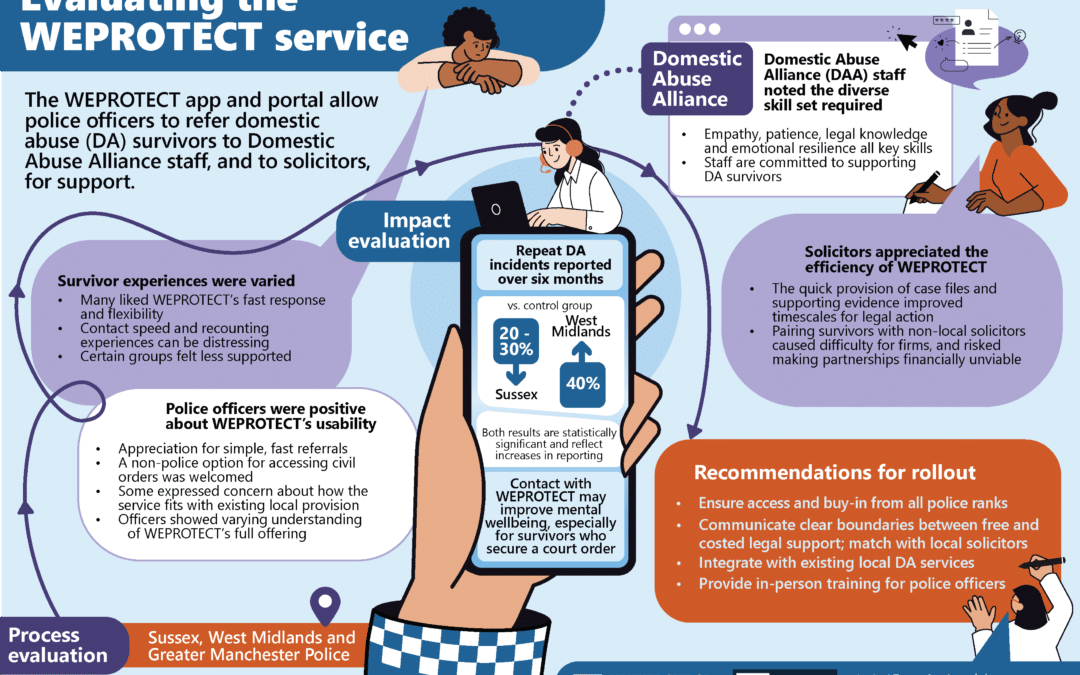
In Sussex, the evaluation identified a reduction of up to 30% in reported revictimisation within six months for survivors referred through WEPROTECT, compared to a matched group acting as a control site.
Of all the evaluation sites, the Sussex pilot ran for the longest period, and the data was the most detailed, allowing for robust statistical methods to match the treatment and comparison groups. The associated estimated economic benefit of using WEPROTECT was between £2.2m – £4.1m in cost savings from reduced revictimisation. After considering the evaluation results, WEPROTECT is now being rolled out across the entire police force.Detective Superintendent Ben Newman of Sussex Police said:
“WEPROTECT has transformed how quickly we can connect survivors to meaningful legal support. Our officers found the referral process simple and fast, and survivors repeatedly told us they felt reassured by the rapid follow-up from the WEPROTECT team.”
Strengthening the frontline response
We have seen that the effectiveness of WEPROTECT depends not only on the technology itself, but on how it is embedded within frontline practice.
The evaluation highlights the importance of senior leadership support, officer training, and strong local partnerships in delivering consistent outcomes.
The service was also trialled in Greater Manchester Police across multiple districts, and within West Midlands Police through its Rapid Video Response (RVR) teams, demonstrating how WEPROTECT can be integrated into different operational models.
Across all areas, police officers described the referral process as “extremely user-friendly”, highlighting how quickly they were able to connect survivors to meaningful legal support. Survivors also reported feeling reassured by the speed of contact, flexibility of communication, and clarity around legal processes, helping them feel safer and more informed.
Wider policy context
The evaluation findings align with broader national priorities to improve the policing response to domestic abuse and place victims at the centre of policing.
A recently published Government White Paper, From local to national: a new model for policing, sets out plans for reform across policing in England and Wales, with a clear focus on improving outcomes for victims.
Jess Phillips, Minister for Safeguarding and Violence Against Women and Girls, said:
“Domestic abuse is a devastating crime, but no government can tackle this issue alone. That’s why we welcome forces doing things differently, finding practical ways to support victims and get them protection faster. But this mission continues. We will deploy the full power of the state to halve violence against women and girls in a decade.”
The evaluation also supports the ambitions set out in the UK Government’s Freedom from violence and abuse strategy, which commits significant investment into victim support services and highlights the role of innovation in strengthening responses to domestic abuse.
Looking ahead
The evaluation sets out a number of recommendations to support future development, including:
- Continued monitoring and national expansion of WEPROTECT
- Enhanced training for frontline officers
- Stronger integration with local domestic abuse services
- Clearer communication with survivors around legal aid
- Tailored support for neurodiverse, disabled, and male survivors
Our commitment
This evaluation provides strong evidence that this approach is making a meaningful difference, both for survivors and for the professionals supporting them.
Razi Hassan, co-founder of Domestic Abuse Alliance, said:
“Our mission has always been to make legal protection faster and more accessible so that survivors can secure legal protection and start to feel safe again. This evaluation clearly shows that WEPROTECT is doing exactly that.”
We will continue to work in partnership with police forces, local authorities, and specialist services to strengthen referral pathways, improve consistency, and ensure that more survivors can access protection at the earliest possible stage.